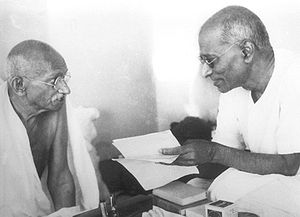
Keeper of the Mahatma's Conscience

Media_httpuploadwikim_ggwww

In reading about George Will's article about FDR's National Recovery Administration, I thought about India's License Raj. To my surprise, I discovered that the term was coined way back in the fifties by Chakravarti Rajgopalachari.

Until a few years ago, if you had asked me about CR, I might have remembered him as the as the second and last Governor-General of India, during the post-independence dawn of 1948. But two years ago, I came across an English rendition of Ramayana written by him, and liked his writing style combining a respect for the storyline with a nod to those with modern sensibilities.

About the same time, I heard his amazing spoken foreword to the Bhaja Govindam by Adi Shankara. 

When intelligence matures and lodges securely in the mind, it becomes wisdom. When wisdom is integrated with life and issues out in action, it becomes bhakti (devotion). Knowledge, when it becomes fully mature is bhakti. If it does not get transformed into bhakti, such knowledge is useless tinsel. To believe that dnyana and bhakti, knowledge and devotion are different from each other is ignorance.

Looking at his life, there is no doubt that he was an exemplar of what he concluded.


Posted

Thoughts on Tilak

Twenty nine years ago, I participated for the first and the only time in an elocution competition. I was in elementary school, and the event was organized to commemorate the August 1 anniversary for Lokmanya Tilak.

I wrote my version of the speech by cribbing sentences diligently from our history text books. My father was not impressed, probably because I was shortchanging this Marathi idol. It was a Sunday evening, and after critiquing my posture and my gestures, not to mention my lack of forcefulness, he filled a whole sheet of paper in his neat cursive. I diligently memorized the whole thing, stood before the entire assembled school on Monday morning, and parroted his words. I do remember winning a prize (a book on freedom fighters, of course) and a certificate, both items I am sure my mother has kept around somewhere.

Today, as I read between the lines of the Wikipedia entry for Tilak, I marvel at his forceful combination of philosophy, ideas and actions. From teaching mathematics to founding an educational society, from starting a newspaper to creating a pan-Indian political movement, from writing treatises on the Bhagavad Gita to rallying a population around festivals, Tilak was that rare combination of scholar and organizer, journalist and leader, philosopher and preacher.

At a time when everything that was “mass” was crass, and aristocracy was the aspiration, Tilak pioneered an ethos to rouse the mass of people into movement. By creating institutions to make English and Science education widely available, he encouraged new thoughts. With his newspaper, he promulgated unrest and boycotts, thus bringing about mass political participation. In championing public celebration of festivals, he ensured training grounds for a mass of speakers, organizers and leaders, and thus the growth of the Indian Independence movement.

In today’s tech startup terms, it is like having a social media and a platform API strategy.

Modern India, though, prefers history in the style of a Bollywood movie. Start with 1857, flashback to Puru and Akbar, pan along with crowds singing in 1930, raising slogans in 1942 and celebrating in 1947). Add in a dash of military heroes, some sadness, dramatic fighting, and fast forward to happy times of net worth and Jai Ho!

This movie has been given its play by the Indian mass media, albeit for multiple reasons that have changed over time. If you are watching this movie, you are paying for tickets and popcorns with currency notes featuring the hero. It is an amazing feat of movie merchandising that the USA cannot match.

Even in the midst of mass media, mass appeal and mass marketing, there are always the hidden gems. They may be dusty and scratched, but inspiring nevertheless. As I come a full circle today, in writing a blog post about Tilak, I realize that remembrance is just the first step. The next step is to act, on however small a scale, for improvement and independence. The tools are all around us. All that remains is to restart the work again.

पुनश्च हरि अोम् ।

Posted

बोलती जे अर्णव, पीयूषांचे

Ashadhi-web


आम्हां घरी धन शब्दांचीच रत्ने । शब्दांचीच शस्त्रें यत्न करू ।।

शब्दचि अमुच्या जीवाचे जीवन । शब्दें वाटू धन जनलोका ।।

तुका म्हणे पहा शब्दचि हा देव । शब्देंचि गौरव पूजा करू ।।


Words are the only jewels that I accumulate

Words I strive to turn into weapons

Words drive and sustain my life

Words I distribute as wealth to this world

Word alone is God, bear witness, says Tuka

Words alone I use to worship and adore


Words of Tukaram. For this 11th day of the bright half of Ashadha.

In memory of my father. 


Photo Credit: Vinayak Yadav

Posted

Mapping Internet Worlds

Mashups based on Google Maps are pretty common. For one, maps are cool. Second, the API is so convenient and powerful. And viewers (myself included) are suckers for the a panoramic view of the world. 

I remember Twittervision as the original full-browser map with automatic jump-around showing tweets with approximate location. WikipediaVision applies the same idea to wikipedia page edits. 

Both are cool, and serve as a great reminder of the world-wide, near-real-time flows of data. 

Abstract visualizations on the other hand, focus on the activity in a meta-verse without regard to location. Most of the ones I know are related to news, such as the newsmap. Digg has several interesting ones, the stack and the swarm are my favorite. 

But, really, I think there is an opportunity for richer, more interesting and informative visualizations that evoke and key off a sense of space. Such visualizations can create and reinforce a map of the Internet world. Eventually, the places on such an Internet map can become as familiar and evocative as those on a Mercator world map.  

Several people I know would argue for a 3D map with rotating objects, perceived depth and simulated horizons. I believe that richer, more useful ways of escaping flatland exist and work better for 2-D display devices. Which is all I think we will have for the next five years, until we get to retinal displays or direct neural manipulation. 

Google Map mashups bring in cartographic features (forests, oceans, towns, states) which are uninteresting in conjunction with the information streams that are being visualized. We need entirely new features for these kinds of maps. While, Google Earth and several other services provide a "layers" approach for mapping additional data it is tied to a coordinate system of latitudes and longitudes. 

It is difficult to think of a new coordinate system in the abstract. But here is an approach which can lead us there. Let's start from the geo-coordinate system, and create a projection into a defined hyperspace. For example, in the twitter vision case, we can combine a user's geographic information with relationship neighborhoods (as derived from follows-follower graphs). Our transformative matrix and placement algorithms then creates a new twitter-map showing mega-twitter-cities of densely connected groups, rural homesteads of sparse followers and hub-cities of multi-networked people. 

Over such a baseline of cities and neighborhoods, we can visualize transient data (such as links, tweets, etc.) along the temporal dimension. Or we can go beyond ephemeral representation, etching those patterns into pathways between the"twitter-cities" based on the flow of links between the clusters. These could be large highways (e.g. mainstream links) or a network of small roads for niche topics or obscure #hashtags. 

If we build a few such concrete maps across multiple domains, we may be able to define a new abstract coordinate system of consensus. 

Posted

Synthetic Bacteria, DNA Encoded Messages

The ideas and implementation details behind the making of the synthetic bacteria is amazing. The DNA has been "watermarked" and the choice of messages is inspiring as well.

* To Live, To Err, To Fall, To Triumph, To Recreate Life Out of Life
* See things not as they are, but as they might be.
* What I cannot build, I cannot understand.

Posted

NanoSpace - The New Frontier

Media_httpwwwzyvexlab_xjroq

Nano Trek. The space ship Enterprise NCC-1701D of Star Trek was fabricated in one-billionth scale by 30 kV Ga+ focused-ion- beam CVD using phenanthrene gas. Length 8.8 µm. This and more amazing micrograph images.

http://www.zyvexlabs.com/EIPBNuG/2003MicroGraph.html

Posted

Dharma 101 at the United Church of Christ

Om

I gave an overview of Sanatana Dharma at the United Church of Christ a few nights ago. Around 50 people attended, and some stayed around for more discussion. The speaking engagement was part of an outreach effort by UCC for inter-faith dialog, and my participation came about through a fortuitous chain of acquaintances. 

I am writing down (in slightly modified and readable form) some of the salient points that I covered.

I am a Hindu If You Preach Palestinism

First off, I don't call myself a Hindu, just as you don't practice Palestinism.

When the Arabs and Persians encountered the civilization near the river Sindhu, they called the inhabitants Hindu, and the land around and beyond as Hindustan. In the intervening centuries, the label "Hindu" distinguished the population from the invaders, was rarely contested, and then appropriated culturally and socially. But in our discussion, it is better to use the word Dharma, and specifically Sanatana Dharma. 

Dharma Eternal

Sanatana means Eternal, without beginning and without end. Dharma is best left untranslated. Dharma derives from roots meaning "Sustained, Firm" and is the Power or Law behind "Rta", the correct way, the right order, natural justice, harmony and righteousness.

Dharma is therefore Universal, and applies to all beings, times and places. Dharma exists, acts and informs our reality, whether we as beings understand it or not. But those of higher awareness consciously choose to seek, follow and uphold Dharma. Thus, even gods must act based on Dharma.

Dharma can be sought and practiced by anyone, anywhere in any time or age. However, since time immemorial, and throughout the ages, devas and humans have, out of compassion and a sense of duty, left markers and guides for our understanding. These comprise of the shruti (that which is heard), smriti (that which is remembered), puranas (of ancient times), itihasa (history - thus, it was) and numerous sutras (compendia) and bhashyas (commentaries). Shruti is the cosmic sound of truth, heard and transcribed by rishis into a language and structure that can be understood by humans. This knowledge or wisdom is the Vedas which are  "apaurusheya", unauthored and divinely inspired. 

Creation

Cycles of creation and dissolution are accepted to be vast, and work at many levels with different time spans. The Puranas provide detailed lists of the different Manus (progenitor of humans), and the salient kings and rishis of the this and previous ages.

To illustrate, we are now in the SvetaVaraha Kalpa which is this Day of Brahma lasting 4.32 billion human years. We are about half-way through this Day, being in the 4th and final Yuga of the 28th MahaYuga (out of 71) of the 7th out of 14 Manvantara of this Kalpa. This KaliYuga began in 3102 BCE with the Mahabharata war.

You may choose to focus on Creation, however Dharma transcends Creation. Let's hold that thought for a minute, while we think of a Creator. 

Normally, at this point, I take a deep breath and brace myself for Anti-Theistic arguments, but here, I don't need to. 

Now there have been materialistic schools of thought, such as Charvaka, who argued that what we perceive with our senses is all that there is, and when the senses shut off, upon death, there is nothing left, and therefore nothing more. But it has no contradiction with Dharma, because if you accept certain ethics, whether for ensuring more pleasure, or encountering less pain, then you have accepted the notion of underlying Dharma, even if you do not attempt to understand it, but practice it merely out of personal desires. 

Neti Neti

Blind Men and The Elephant
The Blind Men and the Elephant is a great poem based on the fable from India, where six blind men argue about the nature of the elephant. Its a good thing to remember, as we apply our limited senses to conceptualize the Creation and Origins while  being part of the Creation. 

A natural question with positing a Creator, is who created the Creator? And then who created that creator of the creator? And so on, obviously, with no end. Most people when faced with this logical infinity decide that the problem is best left to the immediate Creator, or that it is useless to think of a Creator, or they reject such notions or ignore the issue entirely, or declare that it is not important. 

The Vedas and the Upanishads on the other hand, deem it central to the human condition and provide us with several ways to contemplate Its Nature and arrive at an understanding. 

First, is an approach, called Neti Neti, which means "Neither This, Nor That". It helps us avoid using or applying inadequate words and insufficient perceptions. 

Second is illustrative analogies.

For example, in the Chandogya Upanishad, Svetaketu is asked by his father to do simple tasks such as cutting a fig into smaller and smaller pieces, or mixing salt in water. Svetaketu reasons that while the salt has disappeared, for all practical purposes, it has imparted its qualities to the water. When asked to cut the seed of the fig, Svetaketu, with great effort does so, and realizes that there is still something beyond the seed, which brings forth the fig tree, and is the essence of the fig.  

Similarly, there is an all-pervading and transcendent essence which is the basis for all matter, energy, time, space and beings and is called Brahman. 

Nirguna Brahman is the Formless, Immanent Reality. It is pervasive, and is within you, me, our self. It is the Universal Consciousness. It is the sub-quantum force, the Nothingness below the quantum level which still gives atoms and materials their properties. It is the directive force that ensures that while a typical protein molecule can fold itself in 10^143 ways, in practice it does so in only a few dozen stable and useful ways. 

Third, and most importantly, is a way for us to relate to this impersonal vastness and cosmic infinity in terms of our individual capabilities. 

Sat-Chit-Ananda

Most people when they watch TV don't think about the physics of cathode ray tubes or liquid crystal displays, or the electromagnetic properties of light that allow them to remotely change the channel. Even the physicist comes home and gets engaged in the human drama and emotions that are being played out on the screen. Similarly, most devotees when worshipping need more than the abstractions that we discussed. We all need tangible things we can relate to. 

Saguna Brahman is Brahman with attributes and forms that we can relate to. These attributes help us visualize the Power and Glory and help us in leading the life of Dharma. For their devotees, Vishnu, Shiva and Shakti are the main manifestations of Brahman and worship through them leads to Truth, Awareness and Bliss. That is Sat-Chit-Ananda. 

For you, the Ishta-Devata, or the Cherished Divine takes the form of Christ, and through Jesus you can relate to those attributes such as mercy, compassion, patience and suffering, and it informs your practices and conduct. 

As Krishna explains in the Bhagavad Gita: "To protect the pious and destroy the evil-doers, And reestablish Dharma, I appear from Yuga to Yuga" and  "Those devotees who worship any deity with faith, actually worship only Me, even if imperfectly."

Atman,  Brahman, Moksha and Karma

As Svetaketu's father tells him, Tat Tvam Asi (You Are That), or Brahman is within us, and We are Within Brahman. It is easy for me to repeat this, and understand it intellectually. It is the Understanding, the "just knowing" part which is hard. 

I think we all watched the Winter Olympics last month. It is easy to critique the skiers on their performance. It is a bit more work to put on the skis and listen to an expert skier tell us what to do and explain the techniques. It is harder to apply those techniques. And it is only after doing all those practices, where you stop thinking of the technique, and just know, that you are doing great. The feeling of flow where you are doing something naturally. Similarly, a state of "just knowing" about your true Self, Atman and the nature of Brahman, is called Moksha, and is considered the highest aim that humans should strive for. 

But, perhaps you need more time to reach this Understanding. Or you may not be inclined towards achieving that. Or you may be distracted right now with other things. That is the nature of this world, the Samsara, and most people are born, live and die without realizing that insight, without achieving Moksha. 

How is it that babies have personalities and inclinations? Why are some people more intense in certain endeavors than others? In the Bhagavad Gita, Krishna describes to Arjuna the nature of Atman as indestructible, retaining its essence and yet growing with its experiences. As a person changes clothes, so does Atman change bodies, being reborn again and again, until it achieves Moksha and unites with Brahman.  

Why are some people born with more and some with less? You are free to choose your course of action (Karma), but the consequences of those actions (Karma) are yours as well. 

Thus, Dharma is maintained through Karma and Karma leads to Dharma. 

Practice

Dharma is experiential, and so there is great emphasis on practice. It is a process, a journey of discovery, even as you remain engaged in this world, whether in achieving worldly goals or by renouncing them in favor of knowledge and service to others. 

A great amount of Dharma-Shastras (or Scientific Guide for Dharma) have been written to prescribe daily rituals and practices for Dharma at an individual as well as societal level. They cover topics ranging from hygiene to health, from how to worship to how to gather wealth, and for mindfulness through meditation. The Bhagavad Gita is the quintessential modern manual for practice, with detailed explanations and reasonings behind the different paths, namely: Devotion, Action, Knowledge, Meditation, Renunciation and so on. 

Yoga is the term used in Bhagavad Gita for these paths, and Yoga is the same as "yoke" to join. In the physical Yoga, we join mind and body to be aware, and calm the oscillations of the mind, which in turn helps us in our pursuit of Dharma. 

Other aspects of practice, which might sound familiar to you all, include:

  • japa - the chanting of mantras
  • pooja  - the ritual worship through iconic forms
  • satsang - congregations for devotion and worship
  • bhajan - devotional singing
  • darshan - visits to temples for viewing and focusing on the divine
  • vrata - taking and carrying out vows
  • yatra - pilgrimage
  • yadna - sacrificial ceremonies

Shanti Mantra

The Shanti Mantra is a great non-denominational way to open and close discourses. I think it is a quintessential aspect of our gathering here today. Its easy enough for you to read and recite with me. 

Om

saha nAvavatu (May we be protected together)

saha nau bhunaktu (May we be nourished together)

saha viryam karavAvahai (May we achieve and work together)

tejasvinAvadhitamastu  (May we shine forth together)

ma vidvishawahai  (Let no hate come between us)

Om Shanti Shanti Shanti

Posted

Everyday items can turn against you

Media_httpizdnetcombl_fljnj

The United States Computer Emergency Response Team (US-CERT) has warned that the software included in the Energizer DUO USB battery charger contains a backdoor that allows unauthorized remote system access on port 7777/tcp. Symantec also has posted a detailed write-up about the Trojan.

Its really interesting that the device was compromised during the manufacture itself. This means, either:

1) The product software team used the backdoor for testing and did not think to remove it from the shipping product.

2) The product manufacturing plant modified the software, presumably for testing, and then did not remove it before burning the CD.

3) There was an intentional effort to make this device a payload for malware, to be used for other purposes. All it takes is an employee in one of the teams making a simple "mistake".

Perhaps certain agencies were inspired by speculations, hoaxes, and urban myths around how the US took down Saddam's air defense system with a backdoor through some name-brand printers.

Posted

Gobekli Tepe And Musings on Civilization

Media_httpmediasmiths_iuihb

The Smithsonian reported 15 months ago, about the archaeological discoveries of Gobekli Tepe in Turkey, and their implications regarding the conventional view of the rise of civilization.

The temple seems to have been built more than 11,000 years ago, handily predating Babylonian and Mesopotamian city-states. More interestingly, the discovery sets forward the notion that it was religious belief that compelled herders and hunters to gather together in one place and arrange their affairs, develop craftsmanship and agrarian practices to accomplish the building of the temple and carry out the associated rituals.

Posted

श्रीमान योगी


निश्चयाचा महामेरू |

बहुत जनांसी आधारू |

अखंड स्थितीचा निर्धारु |

श्रीमंत योगी |

Posted